What did Tricentis showcase at Transform 2026 in London?
The most important points in brief
- At Tricentis Transform 2026 Europe in London, Tricentis presented the Tricentis ONE platform. It manages Tosca, qTest, NeoLoad, Quality Intelligence and Data Integrity via a common quality goal.
- This is based on the Enterprise Context Engine from Tabnine, which Tricentis acquired in July 2026. The engine can be operated on-premises, in a private VPC, or air-gapped.
- Since Tosca 2026.1 P1, the Tosca On-Prem MCP Server has been generally available. Agentic Test Automation currently only runs in the cloud.
- British American Tobacco (BAT) estimates the reduction in effort in an SAP pilot with 423 process steps at around 70 percent.
- Tricentis Labs has two solutions in early access, Aida and AgentScore, which independently test applications and AI agents.
Why were we shooting at virtual clay pigeons at a testing conference in London? The answer came on the evening of the first day of the conference. After the Tricentis Customer Innovation Awards ceremony, virtual clay pigeon shooting was on the evening's program, and we put our marksmanship to the test.
Accuracy was also the theme during the day. Around 900 experts from testing and quality engineering met on October 21 and 22, 2026, at London's Tobacco Dock, a converted 19th-century warehouse. Under the motto "The Power of Agentic Quality," the focus was on one question: How can quality assurance keep pace with software development that is constantly accelerating thanks to AI? Steven Bartlett, host of the podcast "The Diary of a CEO," concluded the event with his thoughts on leadership in times of constant change.
For us, the transformation began on the morning of October 21st with Partner Day. Tricentis showcased its platform, the direction of product development, and initial prototypes from Tricentis Labs to its partners. Here are our key takeaways and what we're bringing to the table.
What is Tricentis ONE and what changes for test teams?
Tricentis CEO Kevin Thompson opened the conference with the keynote address "Delivering AI Quality at Scale." His core message: AI is accelerating software development so dramatically that quality assurance must keep pace.
Tricentis' answer is Tricentis ONE, based on the guiding principle of "One View of Quality." Users will define a quality goal, and Tricentis ONE will then select the appropriate functions from Tosca, qTest, NeoLoad, Quality Intelligence, and Data Integrity, coordinate their use, and centrally consolidate the results.
At Partner Day, Tricentis showcased its future direction: from remote MCP servers and autonomous agents to the AI Workspace and Tricentis ONE. Tricentis ONE aims to bring together enterprise context, release risk intelligence, AI-powered exploratory testing, AI agent testing, and AI for on-premises products.
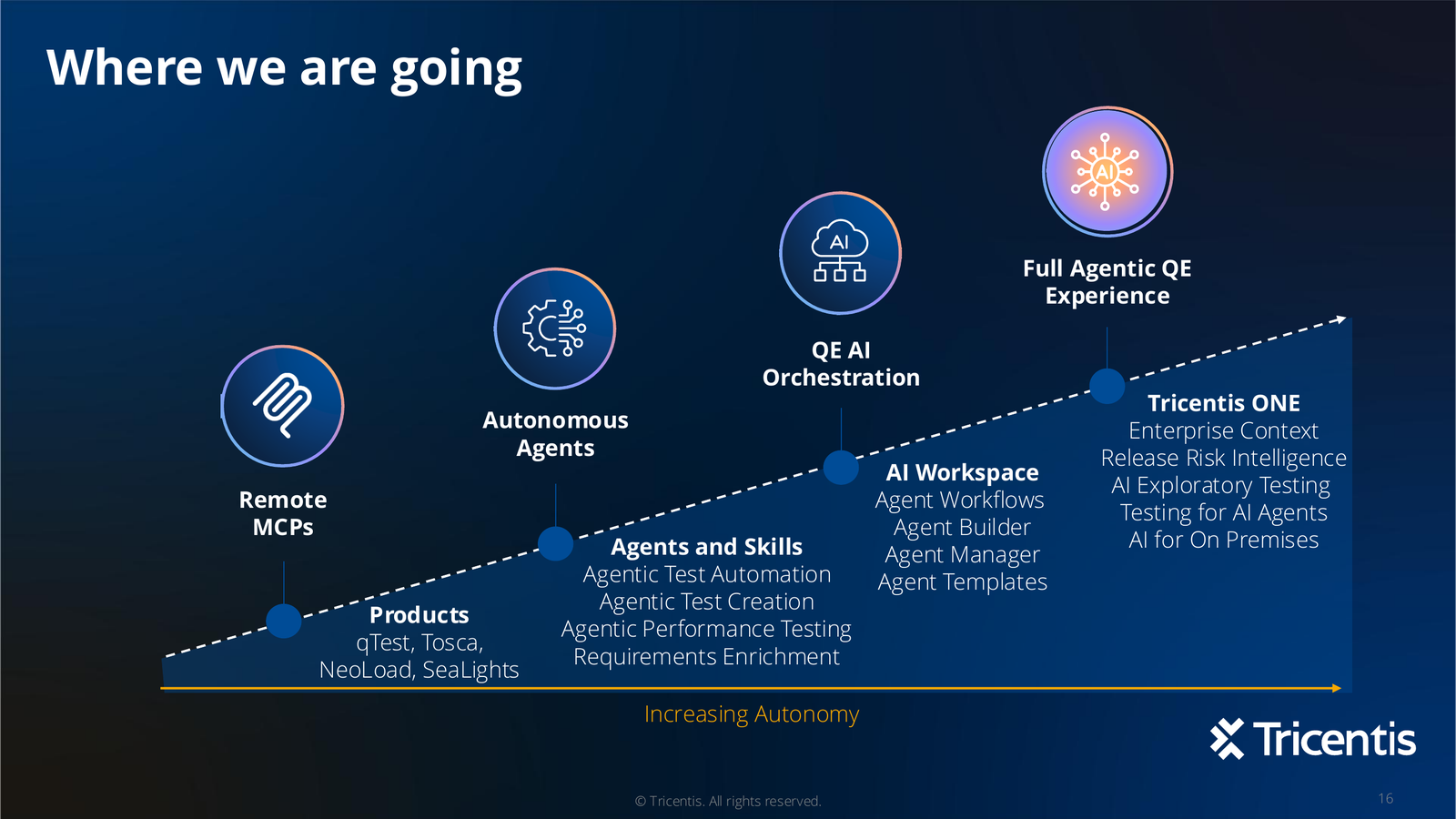
With Tricentis ONE, Tricentis is taking a step towards agentic quality engineering. Agentic quality engineering combines individual test automations into a controlled quality process in which AI agents perform tasks independently. Tricentis also announced AI capabilities for on-premises products and integrations with third-party tools.
Why context is crucial for test agents
The central building block for Tricentis ONE is context. In July 2026, Tricentis acquired Tabnine and integrated its Enterprise Context Engine into the platform. The Enterprise Context Engine builds a continuously updated knowledge graph of the system landscape from code, documentation, tickets, and interfaces. This allows test agents to identify dependencies before taking action.
The Enterprise Context Engine can be operated on-premises, in a private VPC, or fully air-gapped. This is a basic requirement for regulated Swiss companies.
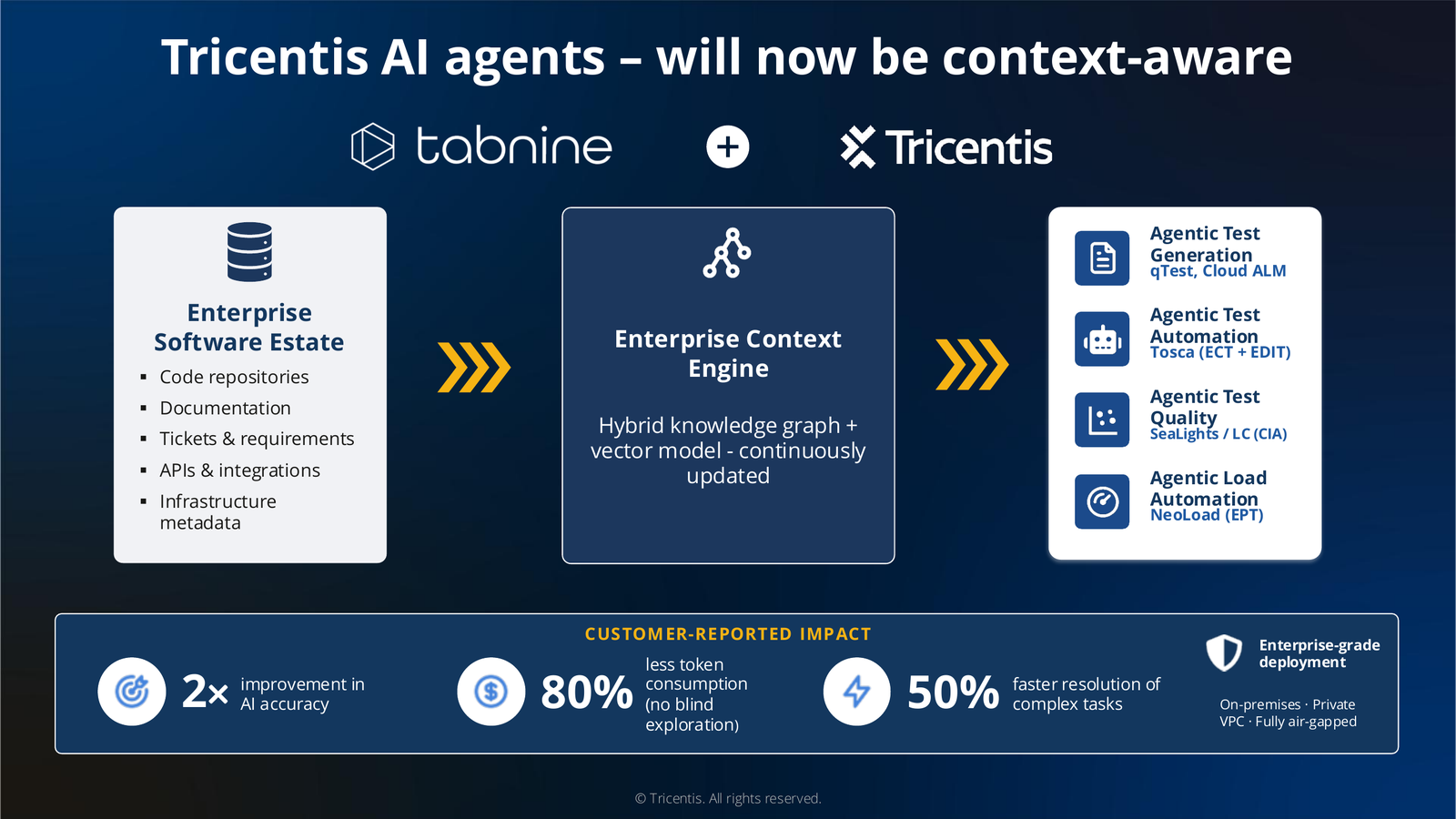
Context directly impacts AI costs. At its Partner Day, Tricentis cited a McKinsey study indicating that 93 percent of companies exceed their AI budgets. The same task can consume up to 30 different tokens. Agents familiar with their environment require less blind searching. Tabnine customers report up to 80 percent less token consumption and up to twice the accuracy. These are manufacturer claims that must be proven anew in each pilot project.
To make AI costs predictable, Tricentis uses AI Credits in its AI Workspace. Teams can analyze usage per person and for the entire organization. For budget managers, this is a prerequisite for scaling agent-based testing.
What Tricentis solutions are available today?
Our assessment: It will be interesting to see how Tricentis ONE handles established testing environments. Many companies run Tosca on-premises, with their own test structures and connections to CI/CD and ALM tools. There is already some progress in this area: Since Tosca 2026.1 P1, the Tosca On-Prem MCP Server has been generally available. It connects AI tools like Claude or Cursor directly to Tosca Commander via the Model Context Protocol (MCP). Agentic Test Automation currently only runs in the cloud, but on-premises support has been announced. For Swiss companies in regulated industries, this point remains at least as relevant as the platform vision itself.
How do companies maintain control over autonomous testing agents?
The more autonomously AI agents operate, the more important control, transparency, and accountability become. Three questions are paramount: Which decisions can an agent make independently? How can its results be verified? Where is human oversight essential?
Tricentis addresses this with transparent agent actions and approval thresholds that can be set according to individual risk appetite. For business-critical applications, clear quality standards within the team are also essential.
Our key takeaway: AI is changing the role of testing specialists. Their experience and judgment are becoming more important because the focus is shifting from test execution to the control and monitoring of intelligent quality processes.
That's precisely why we, as the first Swiss company, offer ISTQB certification training for AI testing .
How did BAT automate its SAP tests with Agentic AI?
British American Tobacco (BAT) demonstrates how AI-powered test automation already works today. The company received the AI Trailblazer Award at Transform 2026 Europe
Using Tricentis Agentic Test Automation, BAT transformed manual SAP test steps into initial automation scripts. The pilot project encompassed 12 business-critical scenarios with 423 manual process steps. Initial scripts were created for all steps, and BAT estimates the effort reduction at approximately 70 percent. Experts reviewed and validated the generated scripts.
The example of BAT shows what a sensible entry point looks like: a clearly defined pilot project, business-critical scenarios, and expert validation by the team itself. AI takes over the tedious work; the responsibility for quality remains with the experts.
Our guide "AI in SAP Testing" shows what such an entry into the SAP environment can look like : four test questions that every release must answer, and an entry matrix for five typical starting points.
What can Tricentis Aida and Tricentis AgentScore do?
With Tricentis Labs , Tricentis has created an incubator where customers and partners can test and help shape new AI technologies at an early stage. Two examples particularly interested us.
Tricentis Aida explores applications independently
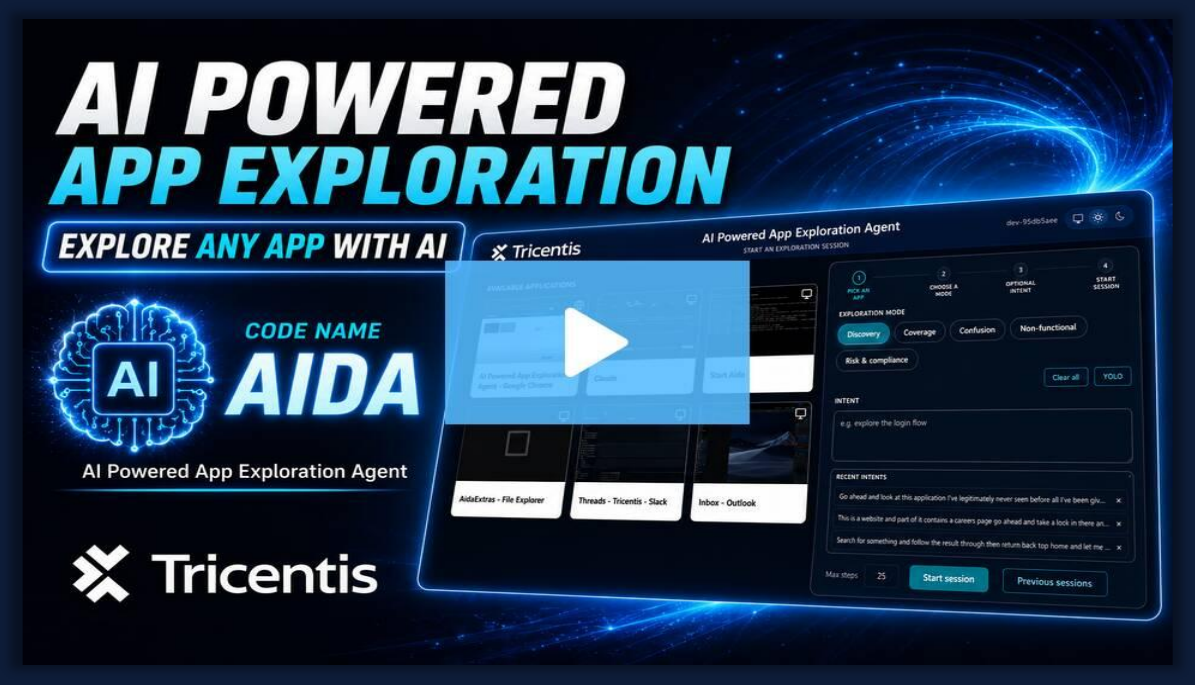
Tricentis Aida autonomously explores web and Windows applications, much like an experienced tester. You specify the application and a focus. Aida maps every screen and logs each finding with screenshots and steps, categorizing it as a bug, warning, comprehension problem, information, or pass. No test scripts or requirements are needed.
We find Aida useful in three situations: for an inherited, unknown application, for a quick check shortly before go-live, and for applications that were quickly built with AI and have not yet been tested.
Tricentis AgentScore rates AI agents
Tricentis AgentScore evaluates AI agents itself. The solution observes how agents behave in real-world workflows, makes their actions traceable, and compares performance across model updates. Three questions are assessed: Did the agent complete the task correctly? Did it stay within budget? Was it fast and reliable enough? This results in a quality score with a recommendation to ship, review, or block.
AgentScore makes testing probabilistic: An agent can reach the same goal in different ways. Therefore, its behavior over many trials is crucial.
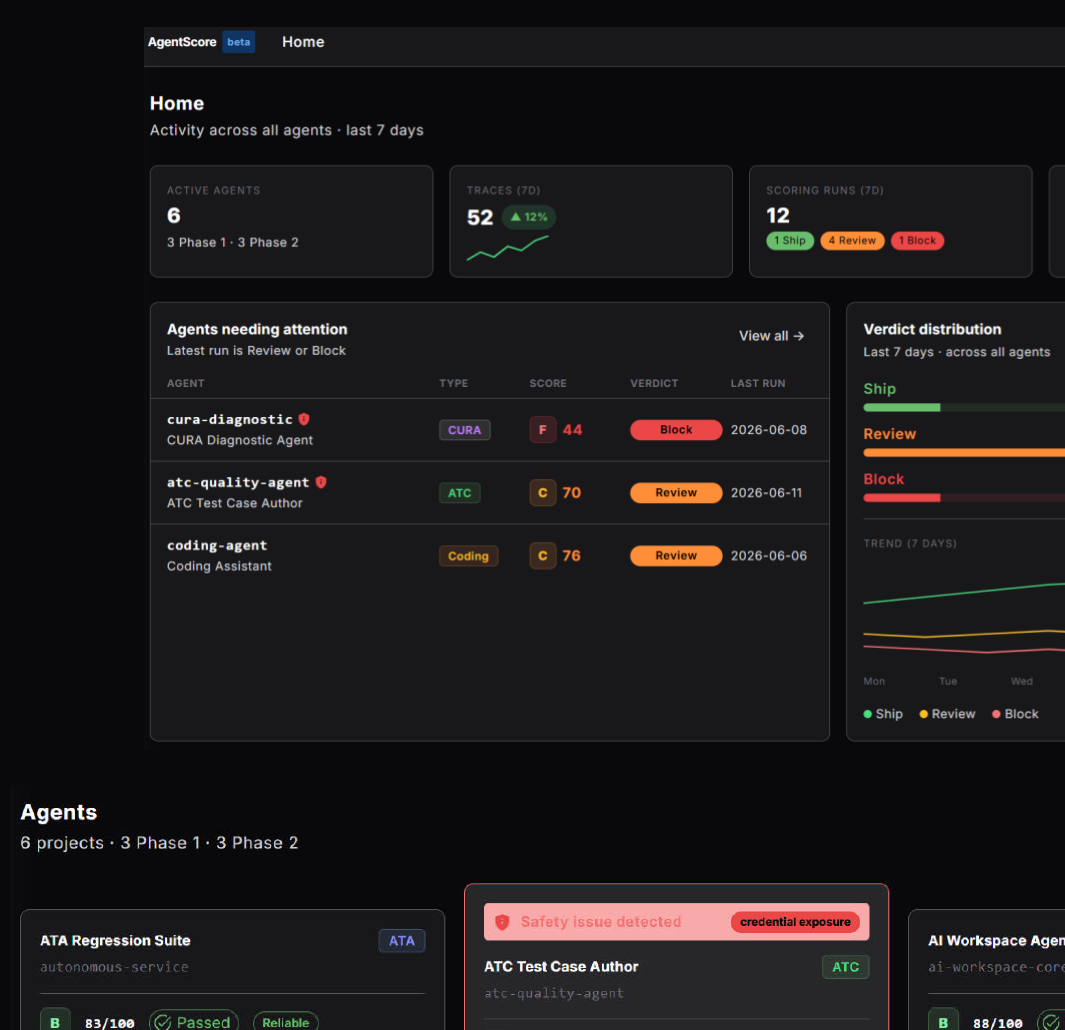
Our assessment: Testing AI agents is becoming a discipline in its own right. In our guide, we call this step "Securing agents," which includes acceptance criteria, behavioral tests before go-live, and monitoring during operation. Tricentis Aida and Tricentis AgentScore are currently in early access.
What are we taking away from London?
What impressed us most were the customer testimonials with figures from real pilot projects, such as those from BAT. Agentic AI has arrived in the testing phase, at least where teams are starting small and measuring its impact.
One concept has remained with us above all: context. Whether Tabnine, AgentScore or Tricentis ONE, the quality of an AI agent depends on how well it knows the system landscape in which it operates.
We've learned that the question is shifting: from "How do we test with AI?" to "How do we test AI?". At Partner Day, Tricentis emphasized this point: AI makes ideas and code abundantly available, but reliable implementation is becoming scarce. This makes quality a top priority for management. Therefore, in future AI pilot projects, we will define acceptance criteria for the agents themselves right from the start, in addition to the criteria for the generated tests.
Our advice: Start like BAT with a few business-critical scenarios, a measurable goal, and validation by your expert team. As the first Tricentis partner in Switzerland and Alps CEE Partner of the Year 2026, we support companies with such pilot projects.
Want to know where to best start with AI in SAP testing? Our 12-page guide shows you how, with an entry matrix and self-assessment.
Frequently asked questions about Tricentis ONE, Aida and AgentScore
What is Tricentis ONE?
Tricentis ONE is a platform from Tricentis based on the guiding principle of "One View of Quality." Users define a quality goal, and Tricentis ONE selects the appropriate functions from Tosca, qTest, NeoLoad, Quality Intelligence, and Data Integrity. The results are then centrally consolidated.
What does Agentic Quality Engineering mean?
Agentic Quality Engineering combines individual test automations into a controlled quality process in which AI agents perform tasks independently. Humans set the guidelines, define release points, and remain responsible for quality.
Does Tricentis Agentic Test Automation run on-premises?
As of November 2026, Tricentis Agentic Test Automation runs exclusively in the cloud. Tricentis has announced support for on-premises environments. This point is particularly relevant for regulated Swiss companies.
What is the Tosca On-Prem MCP Server?
The Tosca On-Prem MCP Server connects AI tools like Claude or Cursor directly to Tosca Commander. It has been generally available since Tosca 2026.1 P1 and can be used in existing on-premises installations.
Why did Tricentis acquire Tabnine?
Tricentis acquired Tabnine in July 2026 to integrate its Enterprise Context Engine into its own platform. The engine builds a knowledge graph of the system landscape from code, documentation, tickets, and interfaces. This allows test agents to identify dependencies before taking action.
What are Tricentis Aida and Tricentis AgentScore?
Tricentis Aida autonomously explores web and Windows applications, logging each finding with screenshots and steps taken, without requiring test scripts or requirements. Tricentis AgentScore tests AI agents in real-world workflows and recommends Ship, Review, or Block. Both solutions are currently in Early Access.
How do I start an AI pilot in testing?
A proven approach involves a few business-critical scenarios, a measurable goal, and validation of the results by the company's own expert team. This is how British American Tobacco proceeded with its SAP pilot project. Infometis, as the first Tricentis partner in Switzerland, supports companies with such pilot projects.