Showcases show the direction, panels show the pulse
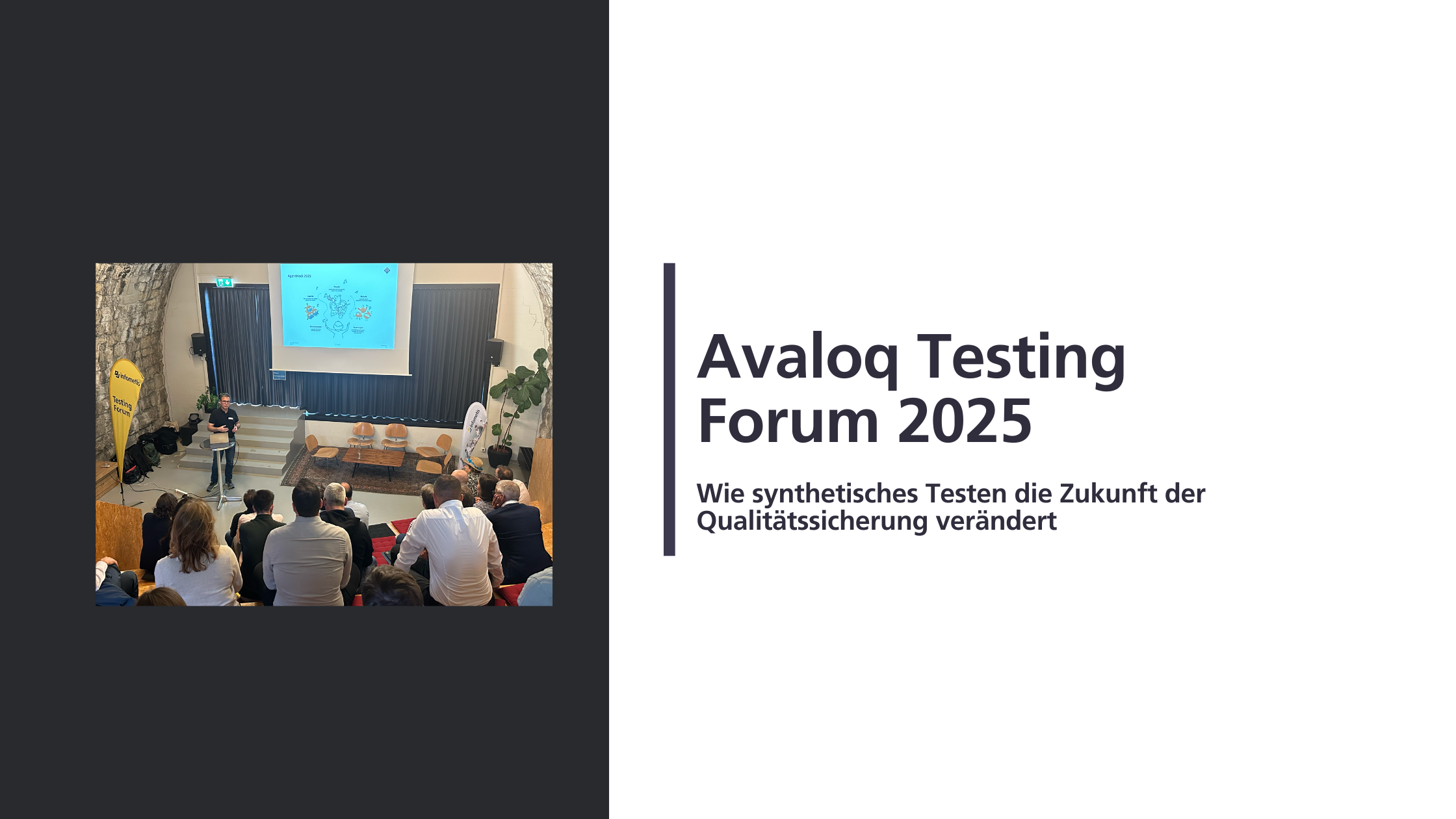
“Would you trust a test case written by an AI without human review?” This question resonated most with our audience at the Info.Lunch: Banking Automation & Testing Forum. On September 17, 2026, quality assurance managers from banks and payment companies in German-speaking Switzerland and Liechtenstein met at Viaduct Arch D in Zurich. Major banks, retail banks, and private banks were represented.
As announced in the last edition, we have opened the forum to participants beyond Avaloq this time. It is now aimed at the entire Swiss FinTech industry and remains focused on its core mission: quality engineering in banking.
Four perspectives on everyday testing
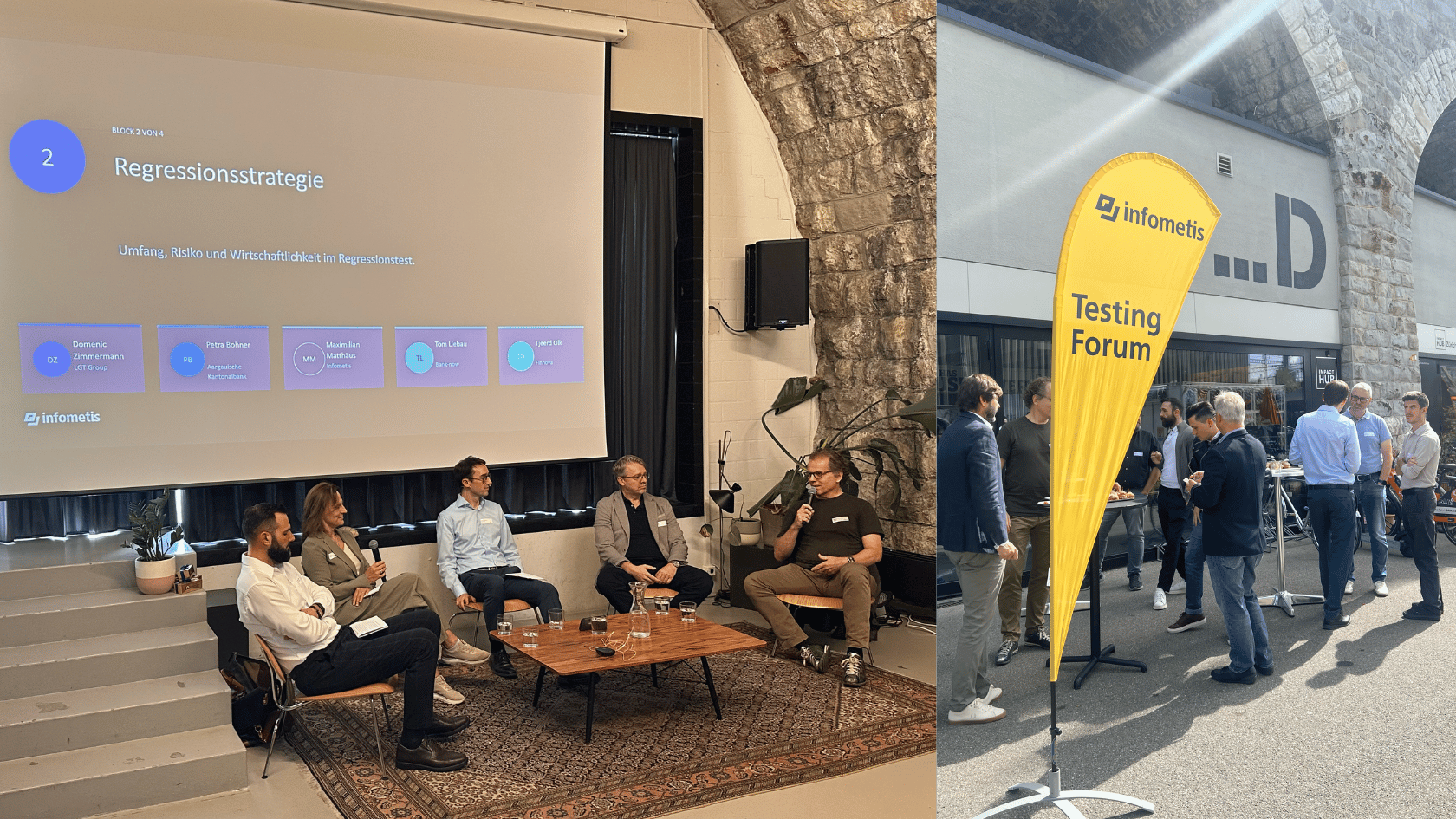
The event centered on a moderated panel discussion covering four topics relevant to the daily testing practices of banks: production incidents and error culture, regression strategy, the quality of purchased software, and AI in testing. Maximilian Matthäus (Infometis) moderated the discussion, which included:
- Domenic Zimmermann, Head of CoE Testing, LGT Group
- Petra Bohner, Head of Solutions & Projects, Aargau Cantonal Bank
- Tom Liebau, Team Leader Test Center of Excellence, Bank-now
- Tjeerd Olk, Product Owner Quality Enabling, Finnova
Banks and software vendors have different perspectives on test automation: different incentives, different responsibilities, different risk perceptions. This made it all the more striking how similar their approaches, questions, and priorities are in practice. Alongside automation and risk-based testing, the need for agentic quality engineering is growing noticeably.
Production incidents: Solution before questioning blame
All participating companies have clear procedures in place for when something goes wrong in production. The focus is on finding a solution; assigning blame takes a back seat. Incident classification is helpful in identifying where the greatest potential for optimization lies. If an error repeatedly originates from the same source, it's perfectly acceptable to address it. This is done thoughtfully and with the goal of collaboratively and sustainably resolving the problem.
Zero incidents remain a goal. Anyone who wants to keep testing efforts under control is consciously taking a risk.
Our assessment: A risk can only be consciously taken if it is visible. This requires clear answers to three questions:
- Which business processes are critical?
- Where do deviations accumulate?
- What residual risk does the department bear?
Risk-based testing makes this decision comprehensible, also to auditors and regulators.
Regression strategy: Test cases need an expiration date
Everyone at the table is familiar with growing regression sets. Instead of discussing an appropriate number of test cases within the regression set, the group deliberately focuses on test coverage and risk-based testing. Hardly any company has a process that defines when test cases should be removed from the regression. As the complexity of the applications increases, so does the testing effort. The crucial point is to align the set with the changed software after each release and keep it up to date.
Our assessment: A regression set remains lean if equally clear criteria apply for including and removing test cases. Such criteria include, for example, the risk covered, the hit rate across recent releases, or overlaps with other test cases. It is crucial to consciously update the regression set after each release. This task is sometimes forgotten or given low priority.
Purchased software: Responsible parties instead of those at fault
The panel deliberately left open the question of who is at fault for a production error in purchased software, because it was deemed the wrong question. The focus is on identifying those responsible, not those at fault. Here, too, the aim is to learn together and achieve the best possible outcome. Banks only partially conduct acceptance tests for purchased software. However, they do return software of poor quality to the manufacturer.
The panel disagreed on one point. The banks attributed more than half of the reported problems to the manufacturer, while the manufacturer attributed more than half to the customer.
Our assessment: This difference is a good starting point. Jointly defined acceptance criteria and an agreed-upon classification of deviations bring both sides to the same factual basis before the software goes into production.
AI in testing: From testing with AI to testing AI
According to a live poll, this was the segment that resonated most with the audience. The central question was whether one could trust a test case written by an AI without human review. Tjeerd Olk countered by asking whether a test conducted by humans truly deserved that same trust. Mistakes happen there too, he argued, but we accept them more readily.
At the same time, the landscape is shifting. Testing with AI is becoming testing AI, and this places new demands on one's own skills. Petra Bohner raised the question of how the next generation of testers should be trained if they lack the formative experiences.
Our perspective: This is a question we've been grappling with for some time. As the first Swiss company, we offer ISTQB certification training for AI testing . There, testers learn to methodically examine AI systems and critically evaluate AI-generated results.
The exchange continues over lunch
After the official part, the discussion continued over lunch, including an interactive demo of STAMINA with Benjamin Tan. Virtually the entire audience stayed until the end, even when the catering was slightly delayed. The live poll confirmed what was already apparent in the room: the panel format was well received.
Conclusion
A showcase demonstrates the direction in which a topic is developing. A panel discussion provides the pulse, revealing where banks and manufacturers actually stand today, beyond proofs of concept and pilot projects. Both formats complement each other. This combination makes the Info.Lunch a regular meeting place for the testing community in Swiss banking.
Which of the four topics is currently occupying your team the most? Perhaps you want to streamline your regression set, build acceptance tests for standard software, or implement AI in testing. Get in touch with us, and we'll take a look at your current situation together.
Our thanks go to all panelists for the open discussion, as well as to Tricentis and UiPath for supporting the event. Both sponsors remained independent in terms of content, both in the preparation and during the panel discussion.
Next edition: The next Info.Lunch: Banking Automation & Testing Forum will take place in March 2027 (exact date to follow). If you would like to be invited directly, please contact maximilian.matthaeus@infometis.ch. Previous participants will receive another invitation.