UiPath and Tricentis are once again among the leaders. But the most important change concerns the understanding of software quality.
AI agents write code, modify applications, and accelerate software development. This also increases the challenge of reliably testing this software. Rapidly generated code requires clear requirements, robust tests, and transparent decisions about its quality.
The Gartner Magic Quadrant for Agentic Software Quality Assurance Platforms 2026, published on October 6, addresses this development. Even the new name reflects the change: "AI-Augmented Software Testing Tools" are now platforms for agentic quality assurance.
For us at Infometis, this is an important development. The focus is expanding from individual automated tests to the coordination of quality across the entire software development process.
What will have changed compared to 2025?
In our contribution to the Magic Quadrant 2025, we described the rise of autonomous testing agents. The current report focuses on their interaction.
An AI assistant, for example, helps in creating a test case. An agent-based platform should also understand requirements, plan tests, coordinate their execution, analyze results, and return insights to humans or other agents.
Gartner describes this as a transition to continuous quality orchestration: specialized agents take over related tasks across multiple tools and development phases.
Two forecasts illustrate the expected direction:
- By 2030, AI agents are expected to initiate, coordinate, execute, and analyze more than 50 percent of software tests in companies.
- By 2028, 65 percent of quality engineers are expected to use command-line tools for their QA activities.
These are future projections from Gartner. However, they clearly show how drastically tools and roles could change.
An overview of the supplier landscape in 2026
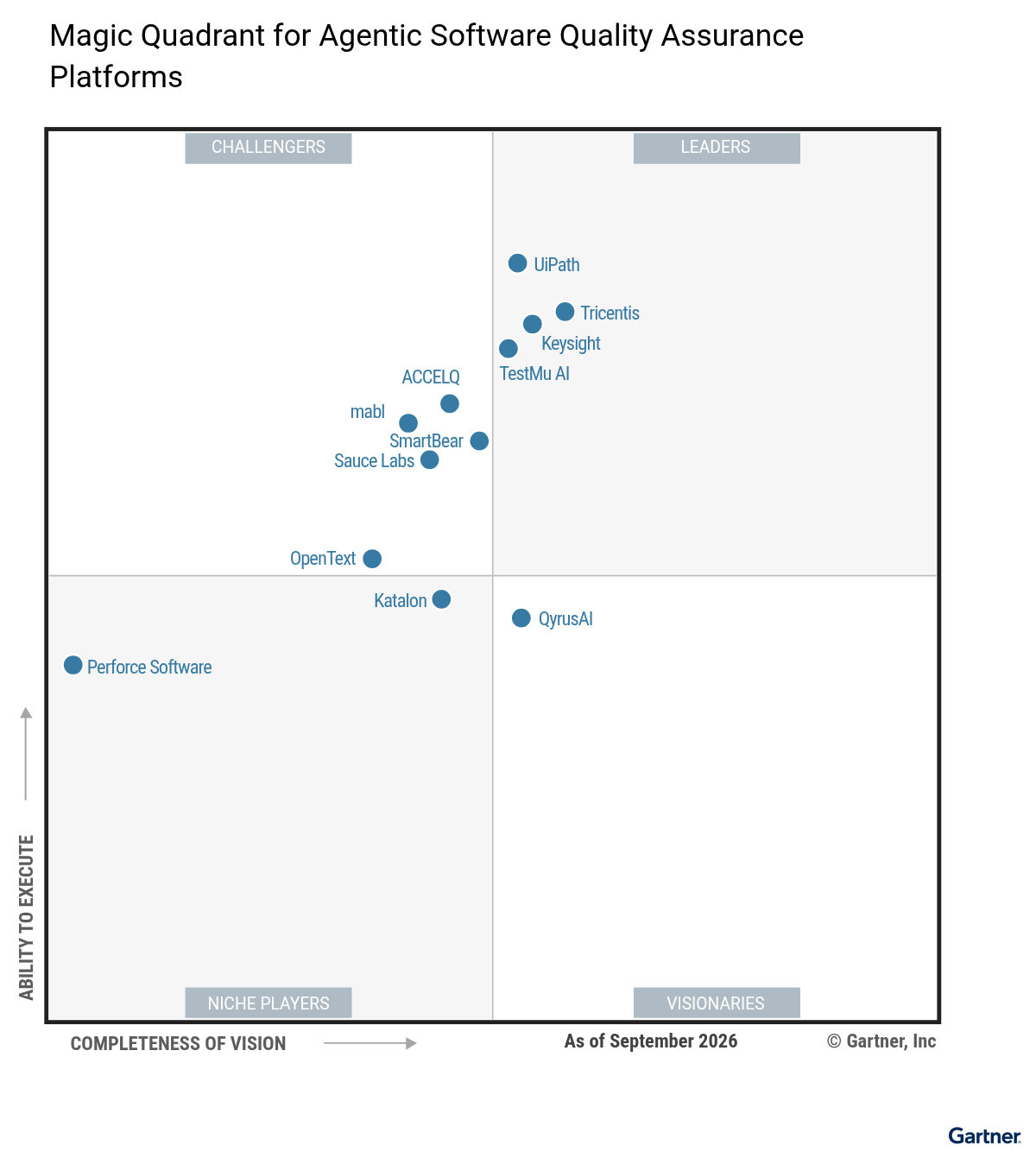
Gartner evaluates twelve vendors based on their ability to execute and the completeness of their vision.
QuadrantProvidersLeadersKeysight, TestMu AI, Tricentis, UiPathChallengersACCELQ, mabl, OpenText, Sauce Labs, SmartBearVisionariesQyrusAINiche PlayersKatalon, Perforce Software
TestMu AI, formerly LambdaTest, is now part of the Leaders group. New additions include mabl, Perforce Software, QyrusAI, and Sauce Labs. Applitools and BrowserStack are not included in this edition.
The changed market definition is crucial: A different positioning or removal from the quadrant does not automatically mean that a product has become worse. Gartner adapts its evaluation and inclusion criteria to the market.
Therefore, the question remains when choosing a tool: Which platform suits our applications, risks, and working methods?
UiPath: Broad platform and consistent agentic vision
UiPath is once again among the leaders. Gartner particularly highlights its broad functional coverage, innovation, and product strategy.
UiPath Test Cloud combines test development, test management, execution, and agent orchestration with governance and human oversight. The report describes, among other things, autonomous application exploration, the execution of naturally written test cases, and a healing agent for test maintenance.
What's exciting is the combination of computer vision, synthetic test data, and accessibility testing with agent-based processes. This allows UiPath to address multiple quality tasks within a single platform.
Our assessment: UiPath is particularly interesting for companies that want to further develop testing and process automation together. Existing automation knowledge can provide a good foundation.
A thorough evaluation remains necessary. Gartner cites the complex, consumption-based pricing of AI as a challenge. Industry-specific governance and audit requirements must also be examined in detail. Therefore, companies should test real-world use cases, costs, and control mechanisms before implementation.
Tricentis: Quality Engineering across a broad enterprise portfolio
Tricentis also remains in the Leaders quadrant. The focus is on the further development of the AI Workspace into a central layer for agent orchestration.
This is intended to coordinate tasks across test development, test execution, performance engineering, test management and release readiness – within the Tricentis portfolio and with tools from other providers.
Gartner particularly commends the company's product strategy, understanding of governance and human oversight, and long-term viability.
Our assessment: For companies with an established Tricentis landscape, this approach offers a possible way to gradually expand existing investments to include agentic capabilities.
At the same time, integration remains challenging. According to Gartner, the products still differ in terms of user experience, workflows, and AI maturity. Therefore, a shared platform vision should be tested against concrete, cross-product processes.
The other providers also deserve a look
According to Gartner, Keysight scores points with its broad technology coverage, including desktop, embedded, and specialized systems, as well as flexible operating models. However, some more advanced agent-based capabilities are still on the roadmap.
TestMu AI combines browser and device infrastructure with agent-based test development and the evaluation of AI agents. Gartner recommends that large or regulated organizations carefully examine support capacity, private deployments, and cost models.
Vendors outside the Leaders quadrant can also be a good fit for certain requirements. A Challenger or Niche Player might be the more sensible choice for a specific use case.
Two tasks: Testing with AI and testing AI
From our perspective, companies need to consider two different challenges.
Testing with AI: Agents generate test cases, maintain automation, prioritize tests, and analyze errors. This focuses on the performance and reliability of the testing process.
Testing AI: The application itself contains AI components. Their responses and decisions can vary. In addition to classic functional tests, suitable evaluations are needed for result quality, robustness, and undesirable behavior.
A platform that generates test cases with AI does not automatically cover the quality assurance of an AI application. These capabilities should be considered separately during evaluation.
What Swiss companies should do now
Our recommendation is to start with a clearly defined use case and answer five questions:
- What quality problem do we want to solve? High maintenance costs, slow regression, lack of coverage, or the testing of an AI application?
- What context do the agents receive? Requirements, business rules, risks, and test data must be accessible and understandable.
- What decisions are they allowed to make? Permissions, approvals, and escalation channels need clear boundaries.
- How do we measure the benefits? Relevant factors include maintenance effort, error detection, throughput time, and total costs.
- How does the platform fit into our environment? Data storage, operating model, existing tools and export options should be examined.
Especially in the case of banks, insurance companies and public administration, traceability and control must be part of the implementation.
Gartner also emphasizes that human judgment remains essential. Quality standards, results evaluation, and release decisions require responsible people.
Our perspective: Agentic testing needs a sound quality engineering framework
More automatically generated tests do not necessarily mean better software. The crucial factor is whether the right risks are covered and whether the results enable sound decisions.
This is where the Quality Tree Framework in: Quality capabilities must align and develop systematically. A high-performance platform only unfolds its full potential when requirements, test data, technical integration, skills, and governance grow in tandem.
My conviction: The role of quality engineers is becoming more important. Their focus is increasingly shifting towards the design, coordination, and independent evaluation of quality processes.
Your next step with Infometis
Do you want to find out which agentic testing capabilities are useful for your company?
Infometis supports you in determining your current situation, evaluating suitable tools, and conducting a pilot project with measurable goals. As a Swiss specialist in quality engineering, we contribute our experience with Tricentis, UiPath, and other testing technologies.
Let's work together to determine where Agentic Testing can add concrete value to your software quality.
Source: Gartner, Magic Quadrant for Agentic Software Quality Assurance Platforms, October 6, 2026, ID G00841424. Vendor positioning: as of September 2026. Statements and recommendations marked "Our Opinion" reflect the perspective of Infometis. Infometis is a partner of Tricentis and UiPath.