More than just testing
The numbers speak for themselves: AI-powered development tools are on the rise in Switzerland. What was a niche topic two years ago is now commonplace in many development teams. Claude Code, Cursor, GitHub Copilot, Agentic Workflows – the toolbox is growing faster than most quality processes can keep up.
This is precisely the point that has been on our minds at Infometis for some time. We have therefore specialized in Quality Engineering, convinced that software quality assurance in the age of AI is a fundamentally new discipline.
What AI is doing to software development
AI impacts the entire development process, from idea generation and coding to delivery and operation in production. Some concrete examples:
Speed is being redefined. Ideas no longer land in a sprint backlog and are implemented four weeks later. Today, they are created as working prototypes within hours. The velocity of teams increases significantly. Many more stories can be realized in even less time.
The developer role is expanding. Specification-to-code processes enable product owners, subject matter experts, and data analysts to generate working code themselves. This presents both an opportunity and a challenge. With the democratization of software development, traditional quality gatekeepers are either eliminated or reduced to significantly fewer people and AI agents.
Agentic AI is involved in the entire process. From ideation and project management to product development: AI support exists for every phase today. Teams no longer operate solely among humans; humans also orchestrate agents as team members.
Opportunities of AI-supported software development
Faster time-to-market is no longer just a marketing slogan. Anyone wanting to launch a new digital service today faces significantly lower barriers to entry than three years ago. This opens up markets, enables shorter innovation cycles, and makes digital products accessible to a much wider audience.
Challenges and risks
As with any new technology, the possibilities and the learning curve are equally steep. Therefore, risks must always be assessed within the context of experience and usage.
What we currently consider important to keep in mind:
- Speed itself becomes a risk factor. What is developed quickly can quickly go into production, due to competitive pressures or the need for innovation. The rate of change thus increases exponentially, and with it, the need for continuous quality assurance.
- IT security and data protection are becoming increasingly important. AI-generated code is not automatically secure code. Known vulnerabilities are reproduced, dependencies are uncritically adopted, or are more difficult to catalog.
- Architectural drift is becoming a real challenge. When changes happen quickly, companies without consistent architecture management lose track of their own system landscape.
- Data quality remains the real gold. AI systems are only as good as the data they operate on. Errors now enter production more quickly and propagate rapidly, or can permanently degrade data sets.
- Agentic behavior defies traditional control. AI agents make decisions at runtime, within business workflows, code generation, or solution finding. System behavior can change in production, either gradually or drastically. Without an active monitoring strategy, this drift remains invisible.
Quality Assurance verifies quality. Quality Engineering builds it in.
The term "shift left" has been circulating in industry for years: the idea is to embed quality early in the process, instead of checking it only at the end. The approach has always been fundamentally correct and important, but it falls short! And yet, it often fails due to the sheer number and complexity of tasks in digitization projects.
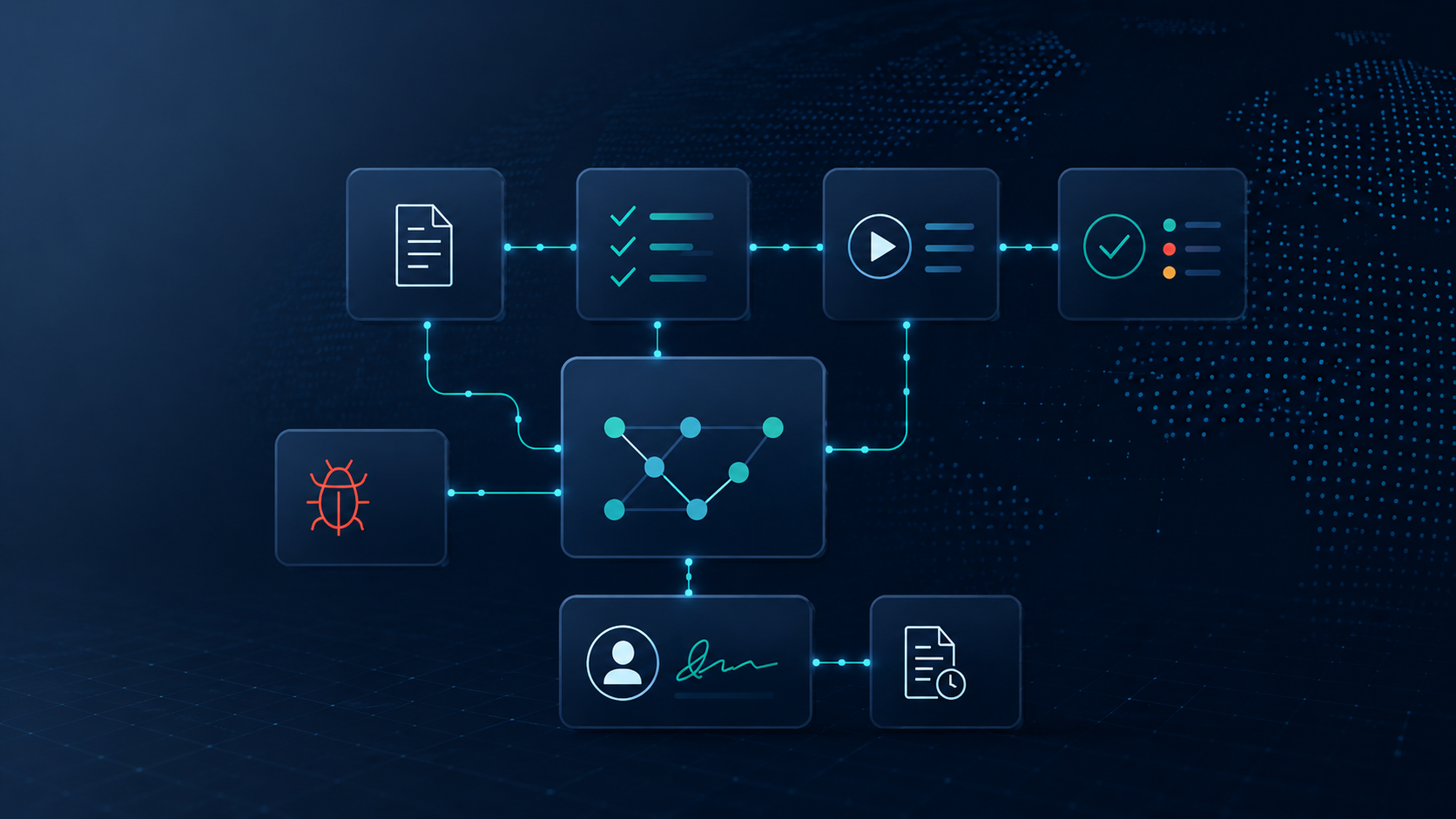
Quality engineering is not a shift. It's a holistic, end-to-end approach. Quality must be created holistically, continuously, interconnectedly, and within the system itself. It begins with defining requirements and extends all the way to operation. Ongoing monitoring, metrics, and anomaly detection via observability are just as essential as the test case before the actual coding begins.
What Quality Engineering specifically encompasses
Requirements as a foundation for quality
Before code is written, expectations, constraints, and risks must be precisely defined. The focus is on strategic and systemic implementation, not formalism. This is especially important because AI systems with incomplete specifications can surprisingly and confidently incorrect things.
Non-functional requirements as first class
The original focus on functional correctness remains. However, security, performance, data protection, and accessibility are moving significantly into focus. In the context of AI-driven development, these are often the most critical quality dimensions. ISO 25010 offers a proven framework here, one that is more relevant than ever. However, in our view, it still falls short. We are therefore prioritizing two new dimensions as additional quality criteria in an Infometis-enhanced version of the ISO 25010 standard:
- Governance
- sustainability
Governance as a new quality criterion
Those who use AI models productively face regulatory obligations (depending on the use case and industry), some of which are already in effect and others that are imminent. Quality assurance today includes the question: How do we ensure that our AI systems behave in a compliant, traceable, and fair manner?
Agents are also increasingly acting autonomously. Decisions are made at runtime, directly in production. This is fundamentally different from traditional software, whose behavior remains stable after deployment.
The EU AI Act provides the overarching framework: Since August 2026, the high-risk obligations have been fully in effect – with requirements for risk management, data quality, human oversight and documentation throughout the entire system lifecycle.
What else is included is industry-specific:
- Finance & Insurance: With DORA (in force since January 2025), banks, insurers, and payment service providers are subject to specific ICT resilience obligations. Those using AI systems for credit assessment or risk models operate simultaneously under DORA, the EU AI Act, and NIS2 – each with its own reporting obligations and deadlines.
- Critical infrastructures and all sectors: NIS2 (in force since 2024) now covers far more companies than its predecessor – including medium-sized businesses in the DACH region. Cyber risk management and governance are becoming top priorities.
- Swiss context: The nDSG , in force since September 2023) applies to all AI applications regardless of technology. Transparency obligations, data protection impact assessments for high-risk systems, and privacy by design are not EU issues, but Swiss legal requirements. For companies with EU ties, the GDPR also applies.
- Medical technology & health: High-risk AI systems in diagnostics or clinical decision support are subject to both the EU AI Act and the MDRrequirements, which presuppose structured quality management.
The consequence for quality engineering: Compliance is not a legal requirement that is checked at the end of the process. It must be integrated into the quality strategy from the outset and is part of the requirements definition, the test specification, and the validation during operation.
Real-time quality instead of in a report
Quality is a continuous process within the system. Therefore, it should be visible at all times as a current state, not as a periodic report. Status, risks, and progress are always present. Decisions are based on data and context. You no longer ask about quality; you see it.
A new discipline: LLM Testing
Those who use Large Language Models in production environments are often entering uncharted territory from a testing perspective. Traditional testing methods need to be adapted for the first time and are only partially effective. What's new:
- Hallucination Testing: How often and under what conditions does the model produce factually incorrect output?
- Responsibility Testing: Does the system adhere to the defined ethical and regulatory guidelines?
- Evaluation Metrics: Instead of binary pass/fail logic, probabilistic evaluation frameworks are needed. Results must be validated using defined metrics, not just checked for correctness.
This requires new skills: not the classic QA engineer who writes test cases, but the quality architectwho accompanies processes end-to-end, orchestrates teams and agents, and brings both technical depth and systemic thinking.
Infometis and Quality Engineering
At Infometis, we take a holistic view of software quality. We combine the three areas of expertise within our internal communities into a cohesive system:
- Business Solutioneers – Aligning business processes with value and fully formulating clear expectations
- Quality Ambassadors – Ensuring quality systematically, continuously and end-to-end
- Automation Genius – Targeted use of agentic automation and AI validation
Our communities will increasingly be enhanced by AI agents in the future. We will orchestrate their use throughout the entire process.
What do we offer?
We have specialized in the complete interplay of quality engineering strategies because we are convinced that it is one of the most important challenges in modern software development.
Our offer includes:
- Quality engineering assessments
for companies that want to understand where they stand and learn more about their potential. - Managed services
for teams seeking a reliable partner to handle partial tasks of quality engineering. - Technology Monitoring:
To provide an overview of technological possibilities, we continuously monitor the market and offer insights into our findings.
In the age of AI, quality is becoming a decisive competitive factor.
Would you like to learn how quality engineering can be implemented in your company? Let's talk about it. Our experts will support you in developing a future-proof quality strategy – from defining requirements to monitoring productive AI systems.
We look forward to the exchange.
This was a first overview. In upcoming posts, we will delve deeper: requirements management in the context of AI, LLM testing methods, and what a modern quality engineering framework specifically contains.