Advantages for modern software projects
Software development is becoming ever faster and more agile – and with it, the demands on quality assurance are growing. Automated UI tests are a central component of modern software projects, enabling early detection of errors and ensuring consistently high quality. While commercial solutions dominated the market for a long time, more and more companies are turning to open-source frameworks like Cypress and Playwright. But why is switching to open-source test automation worthwhile? In this article, we present the most important advantages, differences, and practical applications of these powerful end-to-end testing frameworks.
1. Cost efficiency: No expensive license fees
One of the biggest advantages of open-source testing frameworks is cost savings. Commercial testing tools often come with high licensing fees, while Cypress and Playwright free of charge . Companies not only save on direct licensing costs, but also benefit from a larger developer community that is constantly working on improvements. This is a significant advantage, especially for smaller teams or startups.
2. Flexibility and adaptability of the frameworks
Open-source solutions like Cypress and Playwright are extremely customizable and flexible. Both frameworks offer:
- Open architectures with numerous plugins and extensions
- Support for modern JavaScript/TypeScript stacks
- Integration with test runners like Jest or Mocha
- Compatibility with tools such as GitHub Actions, GitLab CI/CD, Jenkins or Azure DevOps
Thanks to this openness, companies can tailor their test automation precisely to their CI/CD pipeline and technology stack.
3. Extensibility through external libraries
A major advantage of open-source frameworks is the ability to extend them with featuresnot included by default. Thanks to their open architecture, any Node.js libraries or custom helper functions can be integrated.
Examples:
- Extending Cypress with
cypress-axefor accessibility testing - Using
faker.jsfor dynamic test data generation - Integration of
allure-playwrightfor structured test reports - Integration of REST clients for direct API communication within tests
This modularity allows for a tailored testing strategy without being tied to a fixed set of functions – a clear advantage over many commercial tools.
4. Quick setup and easy implementation
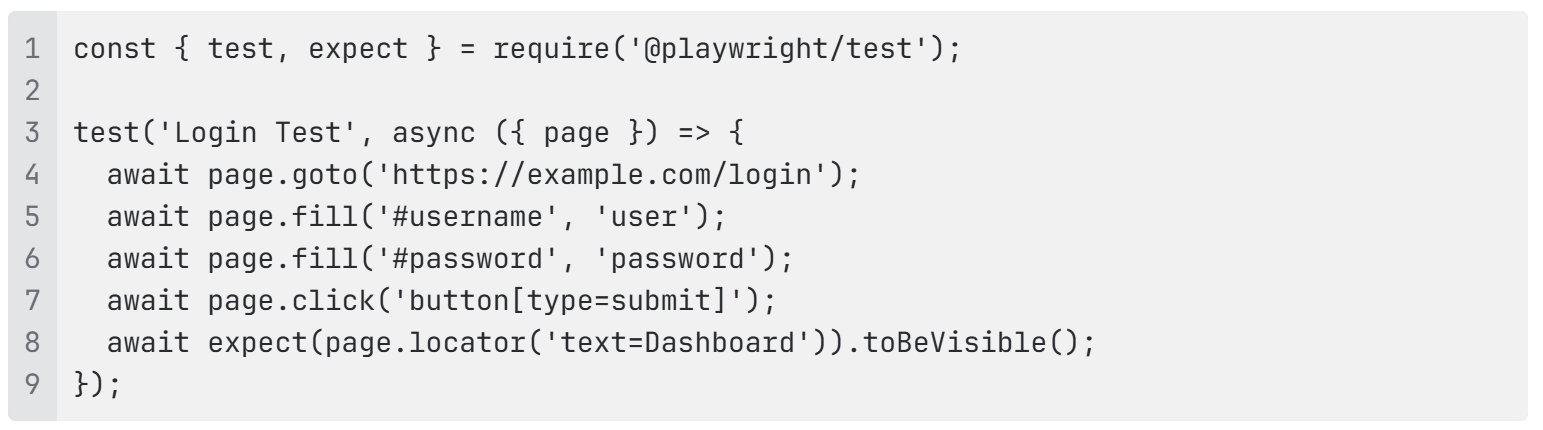
Cypress and Playwright are known for their quick setup and user-friendly syntax. This allows for a quick start – even for developers without extensive testing experience.
Installation in minutes:

Example of a simple UI test in Cypress:

Playwright example:
5. Speed and reliability in UI testing
Both frameworks enable high execution speed and stability:
- Cypress runs directly in the browser context and allows for fast feedback.
- Playwright runs tests parallel and headless , with support for Chromium, Firefox and WebKit.
- Robust retry strategies and intelligent maintenance ensure stable tests.
Especially with extensive regression test suites, these features pay off in the form of shorter runtimes and reliable results .
6. Broad support for browser and mobile testing
A comparison between Cypress vs Playwright shows:
- Cypress: Supports Chrome, Edge and Firefox (no Safari, limited mobile testing)
- Playwright: Supports Chromium, Firefox and WebKit – ideal for cross-browser testing including Safari.
- Playwright also offers device emulation for mobile testing (e.g., iPhone, iPad, Android).
This makes Playwright particularly well-suited for responsive web applications and the emulation of mobile devices in tests.
7. Community, Support and Further Development
Both frameworks benefit from a strong developer community:
- Regular releases with new features
- Extensive documentation and tutorials
- Quick help via GitHub, Discord, Stack Overflow and community forums
While Cypress has already built a large following, Playwright is strongly supported by Microsoft and is growing rapidly – especially in the enterprise environment. A key advantage of open-source frameworks over commercial testing tools lies in their significantly higher release frequency: bug fixes, new features, and improvements are usually available within a few days or weeks. With proprietary tools, on the other hand, it often takes months for updates to be released, which can significantly slow down innovation and bug fixing.
8. Integration into DevOps processes and CI/CD pipelines
Another advantage is the seamless integration into modern development processes:
- Automatic test execution on every commit (CI trigger)
- Support for reporting tools (Allure, Mochawesome, Playwright Test Reporter)
- Screenshots and videos of test errors for easy analysis
Both Cypress and Playwright can be easily integrated into DevOps processes and are ideal for continuous quality assurance.
Conclusion: Open-source UI test automation is the way of the future
Choosing open-source test automation with Cypress and Playwright offers companies numerous advantages:
✅ Cost savings through license-free use
✅ Flexibility and extensibility for individual requirements
✅ Quick setup and easy test development
✅ Robust, fast, and scalable end-to-end tests
✅ Cross-browser and mobile compatibility
✅ Strong community and continuous development
✅ Perfect integration into DevOps and CI/CD workflows
If you're planning to switch your testing strategy to open source or need to decide between Cypress and Playwright, we're happy to support you with expert advice and implementation. Contact us – we'll help you find the best solution for your automated UI tests!